Apparent Solar Time vs Clock Time: Why Your Sundial Is Early or Late
A sundial can be perfectly aligned and still disagree with your watch. That is not a fault in the dial. The Sun keeps local, seasonal time; clocks keep a social, averaged time. Once you separate the three corrections that sit between them—longitude, daylight saving, and the equation of time—the difference stops looking random and starts making sense.
What a Sundial Actually Tells You
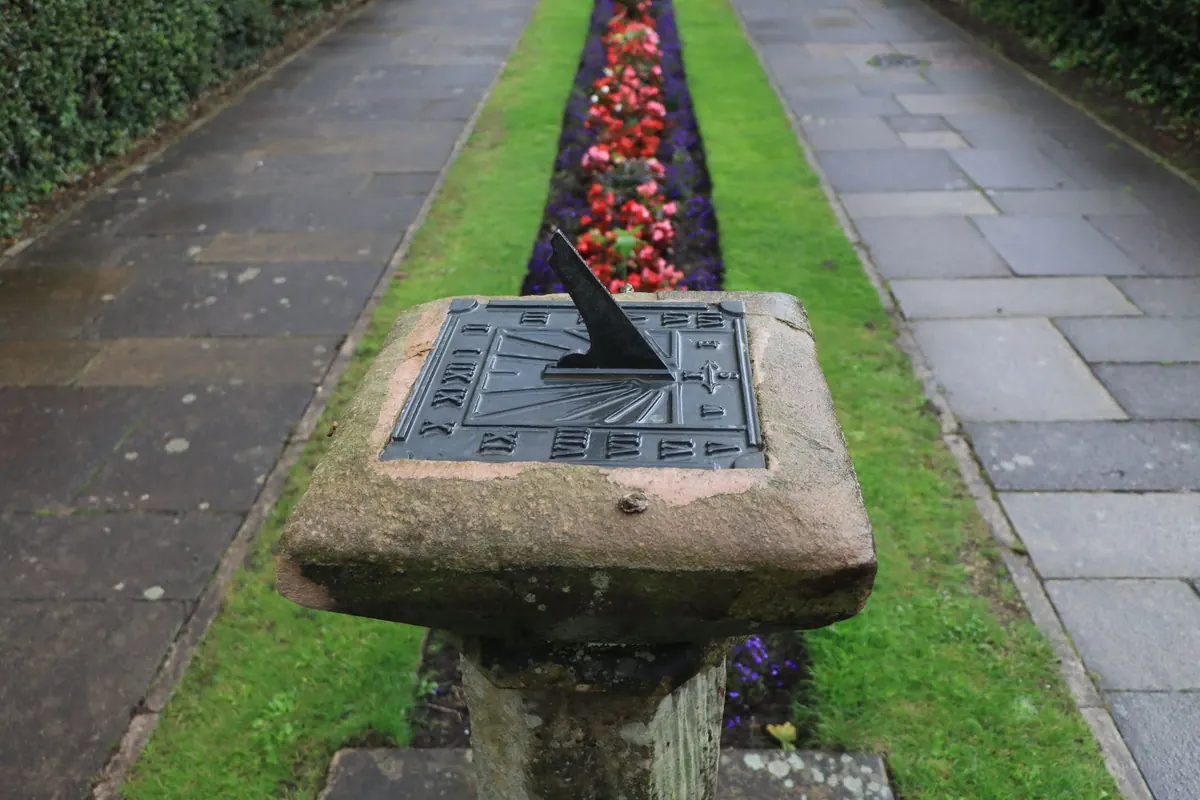
A sundial reads local apparent solar time. When the shadow of the gnomon lies along the noon line, the Sun is crossing your local meridian. That moment is solar noon, not clock noon. It depends on where you stand, not on which time zone your country has chosen.
Clock time is different in kind. It is based on mean solar time, a convenient average of the Sun’s motion, and then shifted to fit a time zone. A time zone pretends that everyone within its borders shares one meridian. Daylight saving time shifts the clock again by an hour. The sundial ignores all of this. It reports what the Sun is doing above your particular patch of ground.
So the comparison is not “sundial versus clock” in the abstract. It is local apparent time versus a standardised civil time. The gap between them comes from three sources: your distance from the zone’s standard meridian, the date-dependent wobble called the equation of time, and any seasonal clock change.
Longitude: Four Minutes per Degree
The Earth turns through 360 degrees in 24 hours. That works out at 15 degrees per hour, or four minutes of time for every degree of longitude. If your sundial sits west of the meridian your time zone uses, local solar time runs behind zone time. If it sits east, local solar time runs ahead.
Take a simple case. Suppose your time zone is based on 15°E, but your sundial stands at 12.5°E. You are 2.5 degrees west of the standard meridian. Multiply by four minutes: the dial’s local mean solar time is about 10 minutes behind the zone’s standard time. At the same moment, a clock set to standard time will read roughly ten minutes later than the sundial’s mean-time position.
This correction is fixed for a given dial. It does not change with the seasons. Write it down once—say, “local solar time is 10 minutes behind standard time”—and you can use it every clear day. Just remember that the sign flips if you move east of the standard meridian.
The Equation of Time: The Sun’s Own Drift
Even if your longitude matched the standard meridian exactly, and daylight saving were switched off, the sundial would still not agree perfectly with a mean-time clock. The Sun’s apparent motion is not uniform. Two things cause the drift: the tilt of the Earth’s axis and the fact that our orbit is elliptical, so our speed around the Sun varies through the year.
What the correction means
The combined effect is called the equation of time. In sign terms, it is apparent solar time minus mean solar time. When the value is positive, the sundial is ahead of mean time; when it is negative, the sundial is behind. The difference is small but real: it reaches roughly plus 16 minutes in early November and roughly minus 14 minutes in mid-February.
The equation of time passes through zero about four times a year, near mid-April, mid-June, early September, and late December. Around those dates, the Sun and the mean-time clock are briefly in closer agreement. At other times, a dial that looks “wrong” may simply be recording the Sun’s true seasonal behaviour.
Why it is not a clock error
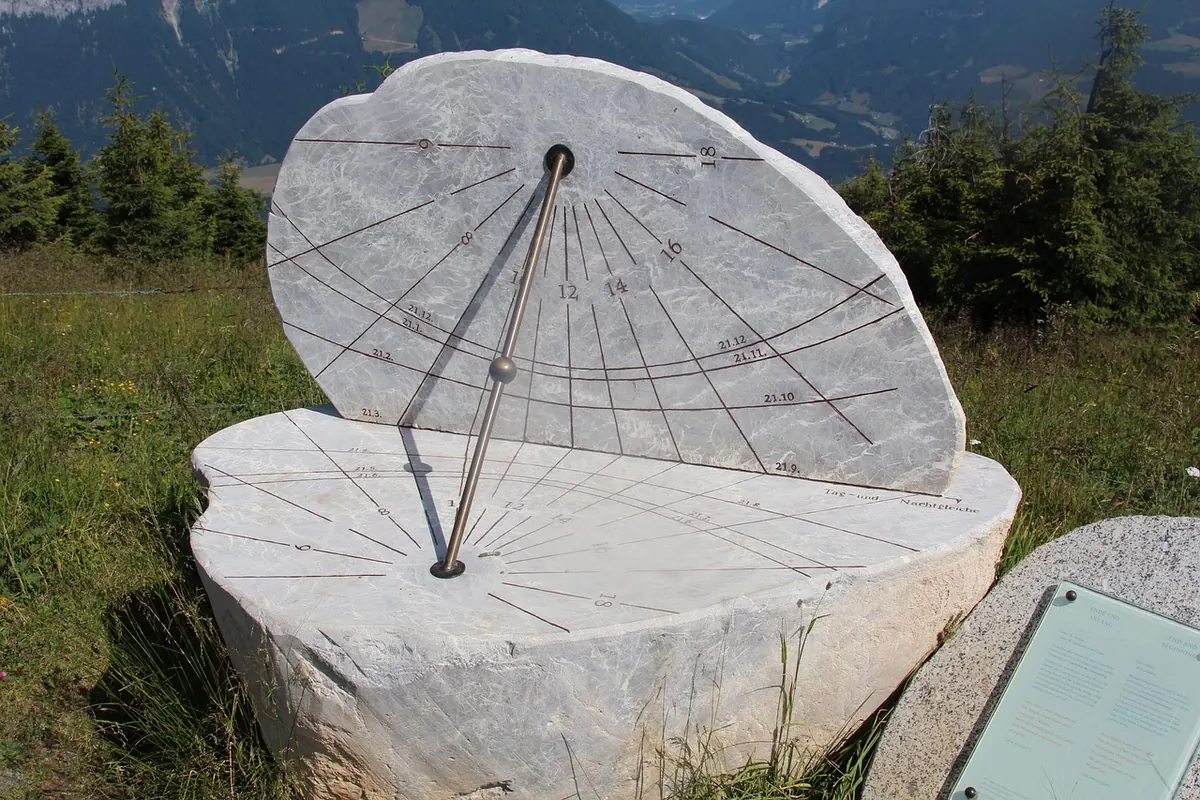
A mechanical clock counts equal hours. The Sun does not. Apparent solar noon can arrive a little earlier or later than mean solar noon, and the pattern repeats each year. This is why serious sundials often carry a small table, a graph, or an analemma—a figure-eight curve—so the reader can convert apparent time to mean time. If your dial has one of those, use it; do not apply the equation of time twice.
Daylight Saving Time Adds an Hour
Daylight saving time is the easiest correction to understand and the easiest to forget. The sundial does not spring forward. When clocks are moved ahead by one hour, the dial appears to lag by about an hour before the other corrections are applied. When standard time returns, that hour disappears from the comparison.
If your region does not use daylight saving time, skip this step. If it does, note the offset for the date you are reading the dial: zero in winter, plus one hour in summer for most participating regions. The exact start and end dates vary by country, so check the local rule rather than relying on memory.
Putting the Corrections Together
To compare a sundial with a clock, work in a fixed order. The arithmetic is simple, but the signs matter.
- Find your longitude and your time zone’s standard meridian. Subtract the standard meridian from your local longitude. Multiply the result by four minutes. East of the standard meridian gives a positive value; west gives a negative one.
- Look up the equation of time for the date. Keep its sign. Positive means the sundial is ahead of mean solar time; negative means it is behind.
- Note the daylight saving offset. Add one hour if daylight saving time is in force, otherwise add zero.
- Convert the reading. Clock time = sundial time − 4 × (local longitude − standard meridian) − equation of time + daylight saving offset.
Here is a concrete example. A dial at 12.5°E uses a zone based on 15°E, so the longitude term is minus 2.5 degrees, or 10 minutes. In early November the equation of time is about plus 16 minutes. With no daylight saving, a sundial reading of 11:30 becomes 11:24 on the clock: 11:30 + 10 minutes − 16 minutes. The dial is ahead by six minutes. In summer, with daylight saving added, the same reading would correspond to 12:24 on the clock.
Quick Checks Before You Blame the Gnomon
Before adjusting anything, make sure the dial is giving you a fair reading. Small setup errors can mimic time corrections.


You Might Also Like
At the winter solstice a sundial's shadow stretches two or three times the gnomon's height. Here is how to plan, expose, compose and protect camera and dial in the cold.
A hands-on family guide to the spring equinox: plant a stick, track its shadow, measure it at noon, and find true north with chalk and a child's height.